Introduction
This post gives a brief description of the process of using a ship lines plan to model its hull surface using a 3D CAD software. The objective of this post is to prepare a hull that can be used in future articles about Naval Architecture.
Methods
Here we describe the chosen ship, the 3D CAD software used to model its hull and the most important aspects of the modelling process.
Ship
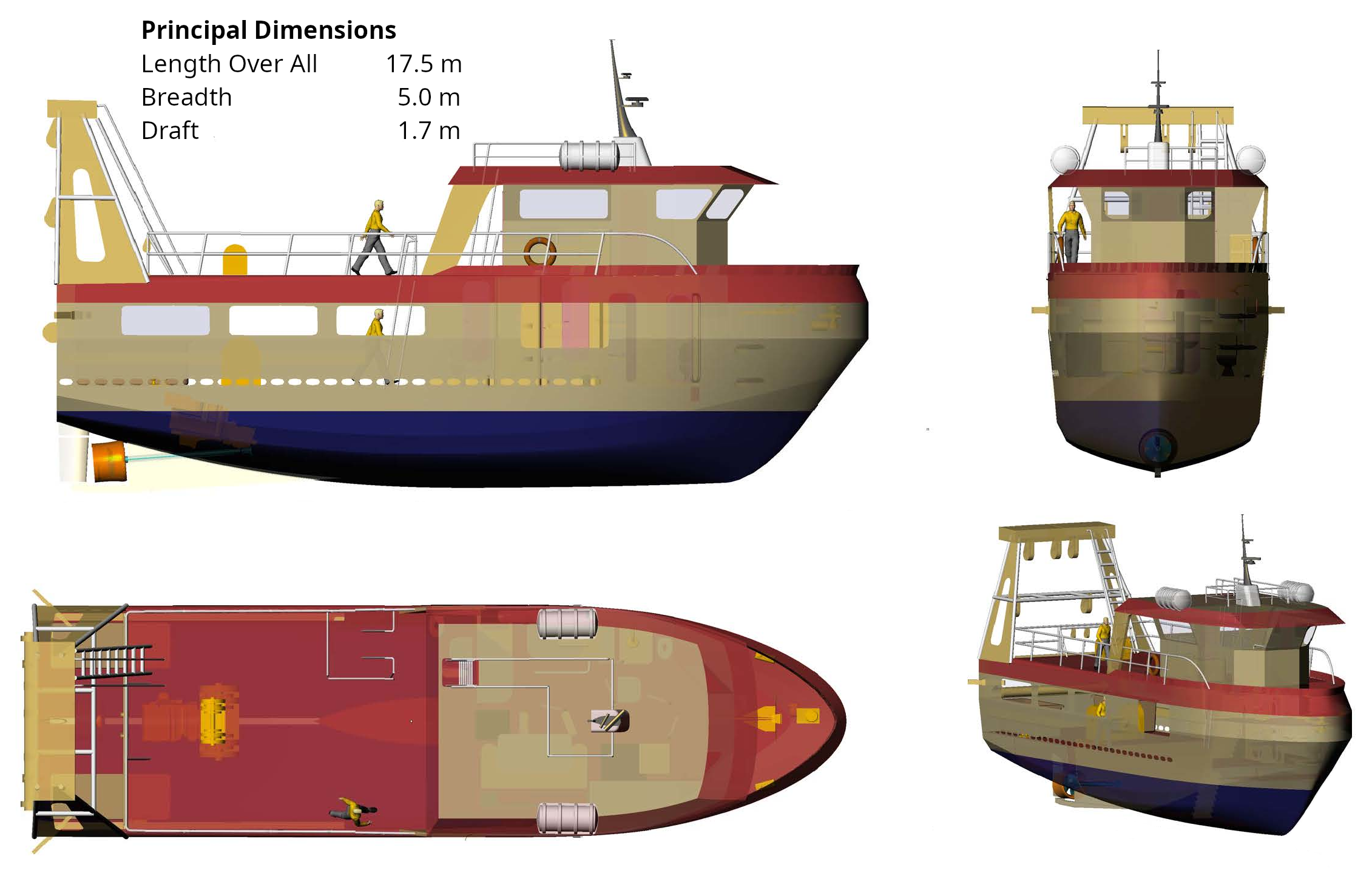
The chosen ship is a trawler designed for Morocco through FAO’s technical cooperation project TCP/MOR/3302. The main reason for this choice lies on the simple geometry of the hull, which will make the 3D modelling a lot easier. Below, there’s a picture of of the trawler’s general arrangement and the lines plan is also provided by the reference.
FreeShip
FreeShip is a free and open source surface-modelling program based on subdivision surfaces and intended for the design of ships. It was originally designed for Windows, but its most current version also provides an installer for Linux. This latest version is maintained by Mark Malakanov in the freeship-plus-in-lazarus project.
Note about FreeShip on Linux
Under my current operating system, Linux Ubuntu, FreeShip is unstable and some features don’t work as expected. For example, after adding background images, it crashes if zooming in beyond a certain point. Also, the dialog box for editing a point’s coordinates vanishes and I have to restart the software to bring it back. Besides these problems, I was able to use FreeShip to model the trawler’s hull, as described in the next subtopic.
Modelling process
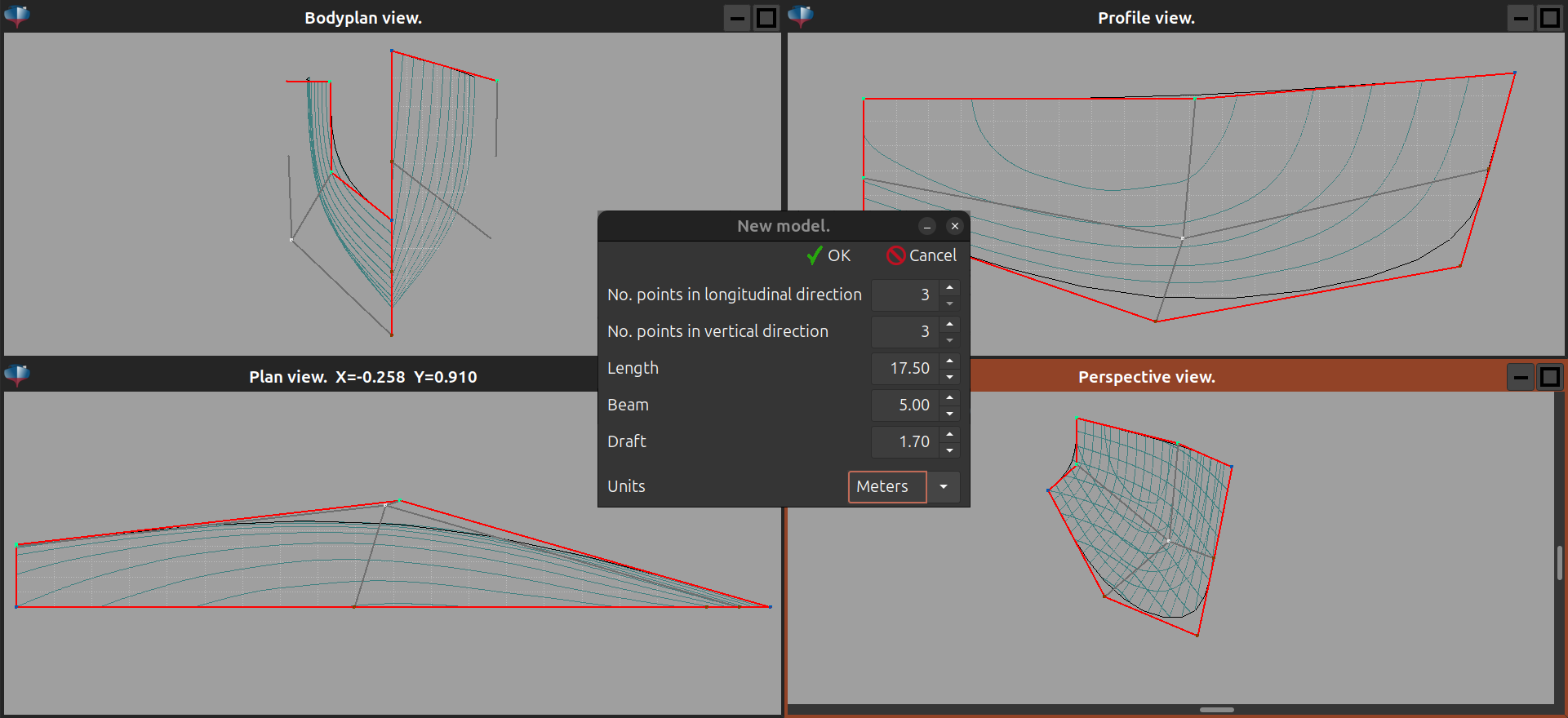
In FreeShip, the modelling process starts by defining the ship’s main characteristics, as depicted in the following image, which also displays the resulting generic surface.
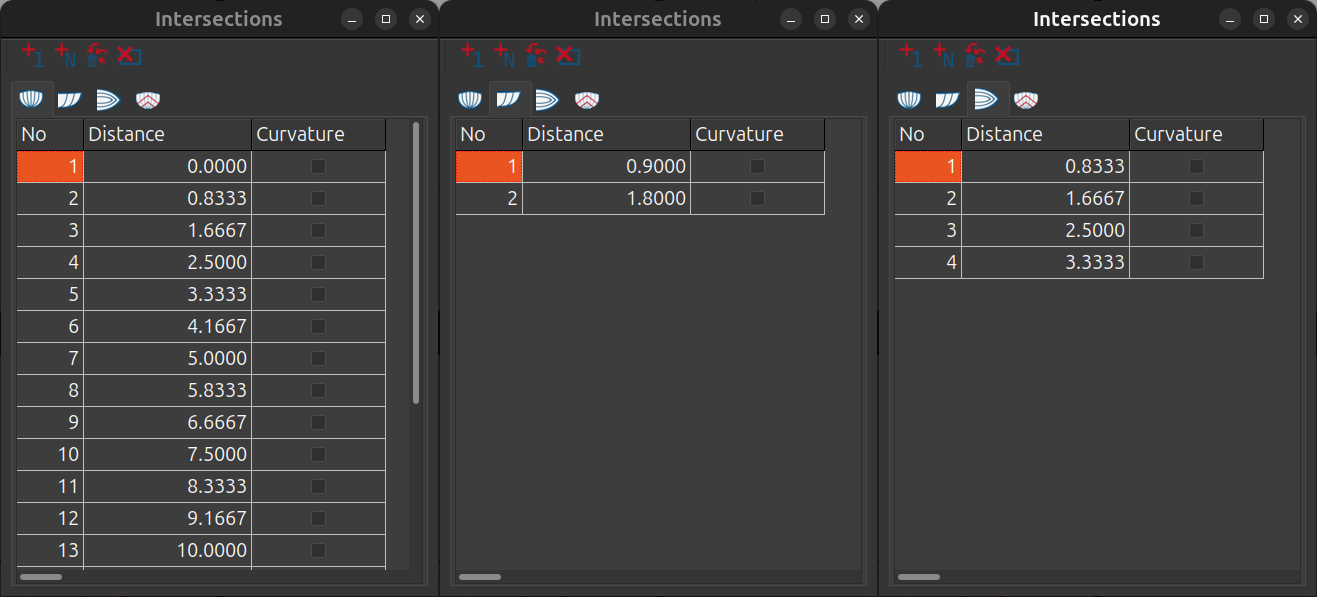
Next, we use FreeShip Intersections to define stations, buttocks and waterlines with the same spacing used in the reference lines plan.
Next, we load the lines plan components into each one of the three views: body plan, sheer plan and the half-breadth plan. After that, we use the Crease command to define edges and corners, represented by red lines in the following picture. Control points in these elements are added and dragged in order to make our model fit the reference drawings in all plans.
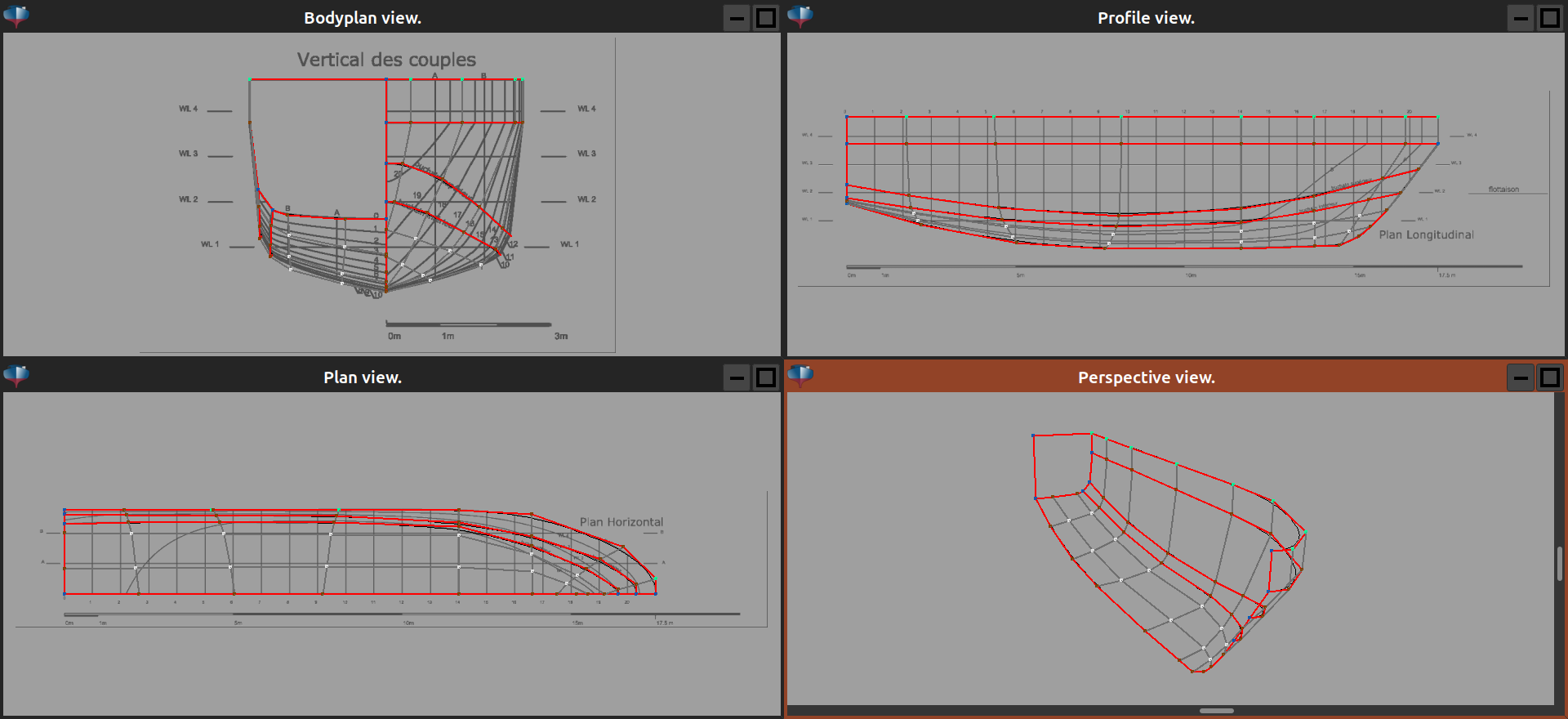
After adjusting edges and corners, we add control points between them to adjust our drawing cross sections to those of the background images. These control points must be added sparingly, in order to keep the surface smooth. Too many control points can make the surface overconstrained and bumpy.
This is an iterative processs, since changing the control points in one view modifies the way the cross sections look in the other two plans. With a lot of patience, one can be build a nice looking hull, as presented in the next topic.
Results
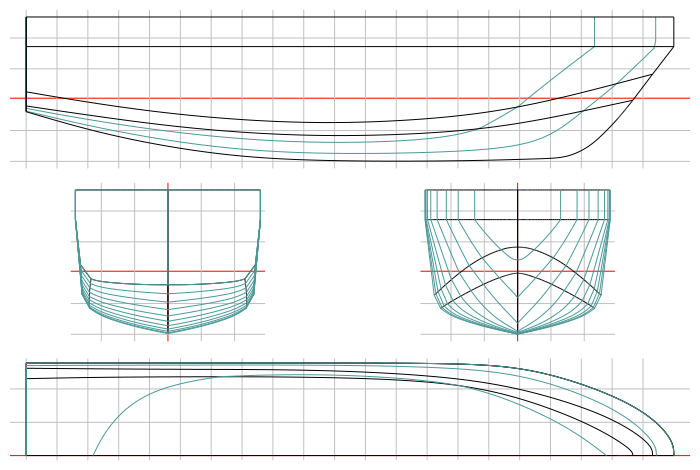
The following pictures show some characteristics of the resulting surface that represents the trawler. We start by showing our model’s lines plan, automatically generated by FreeShip, and exported to a .dxf file.
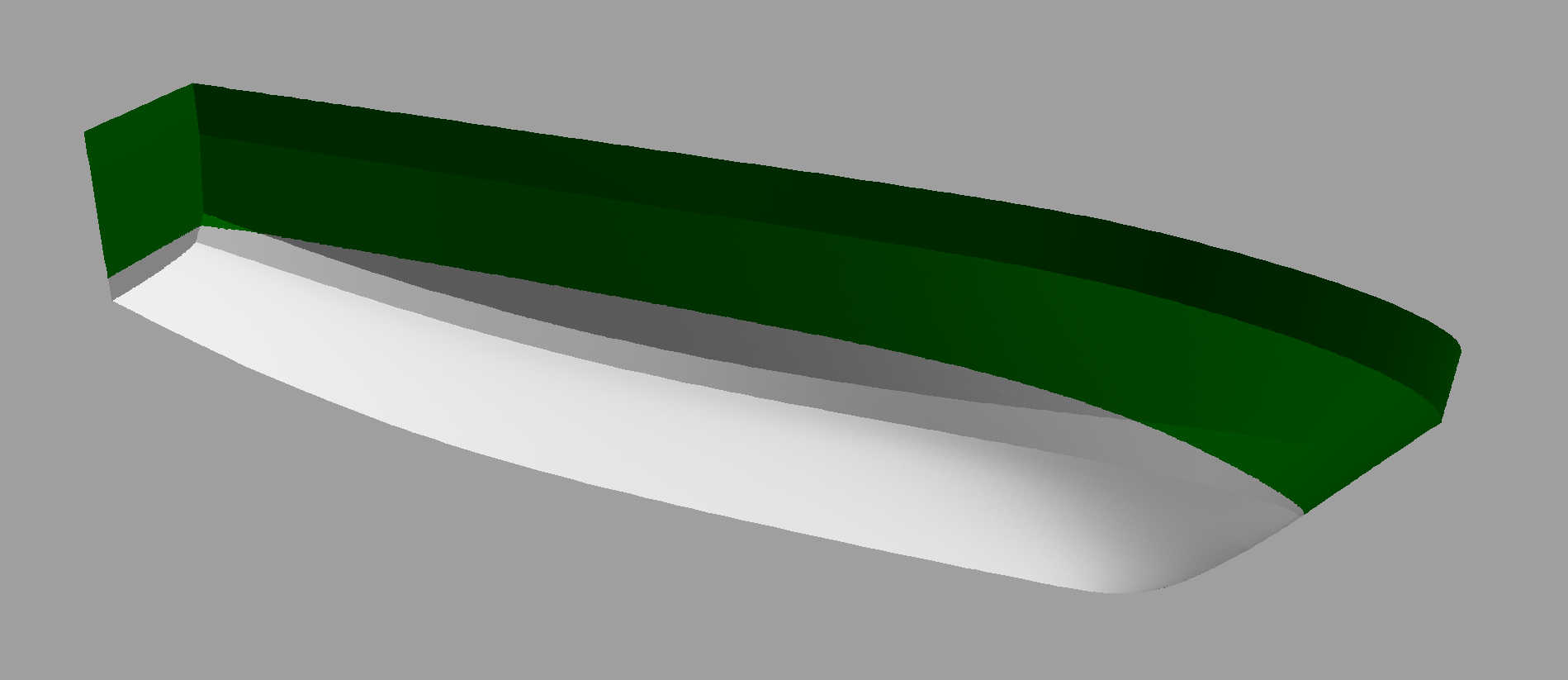
The following picture shows a 3D view of half of the hull’s surface.
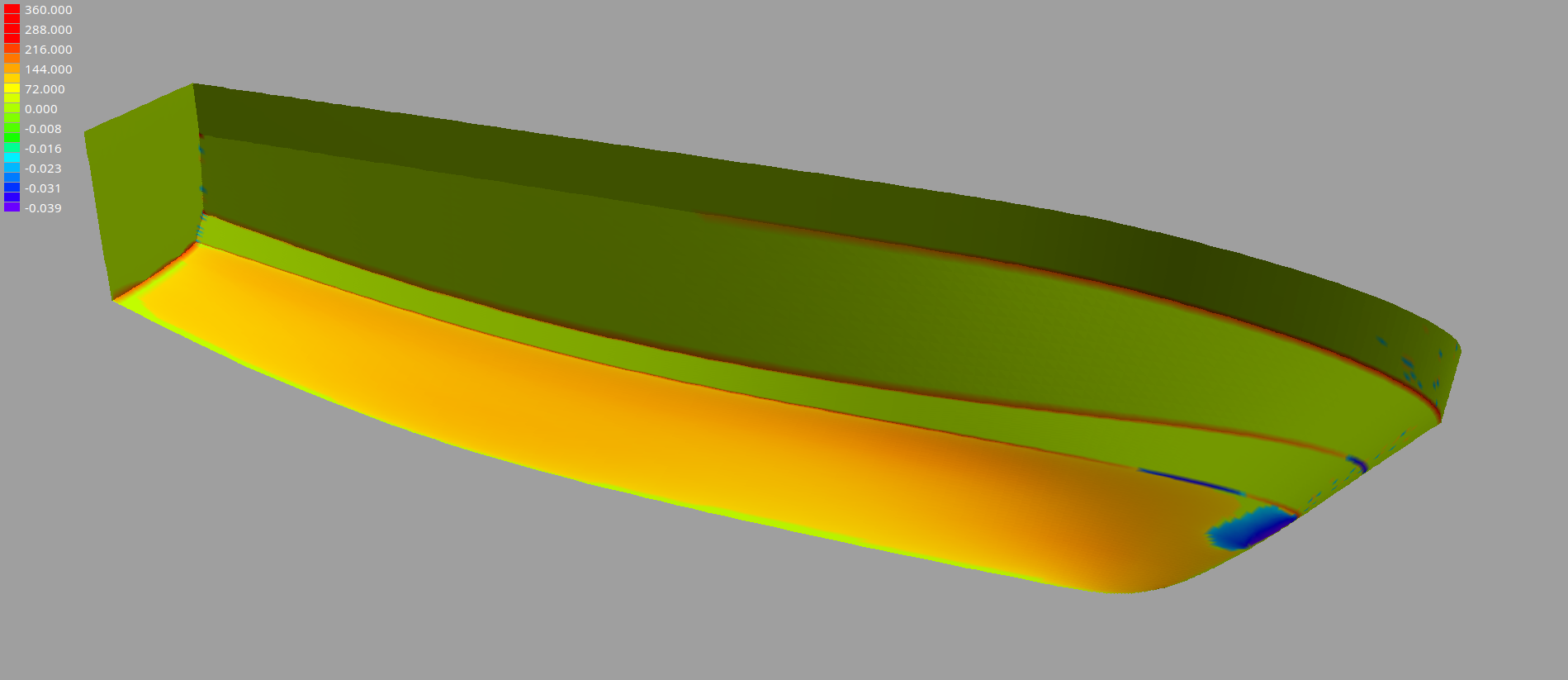
The next two pictures are used to evaluate the hull qualitatively. The Gaussian curvature describes the surface’s smoothness. Regions with an abrupt change of color designate an rough change in curvature. In the following image, the only region behaving in such way is the bow, specially close to the design waterline, which is expected, given the confluence of two edges.
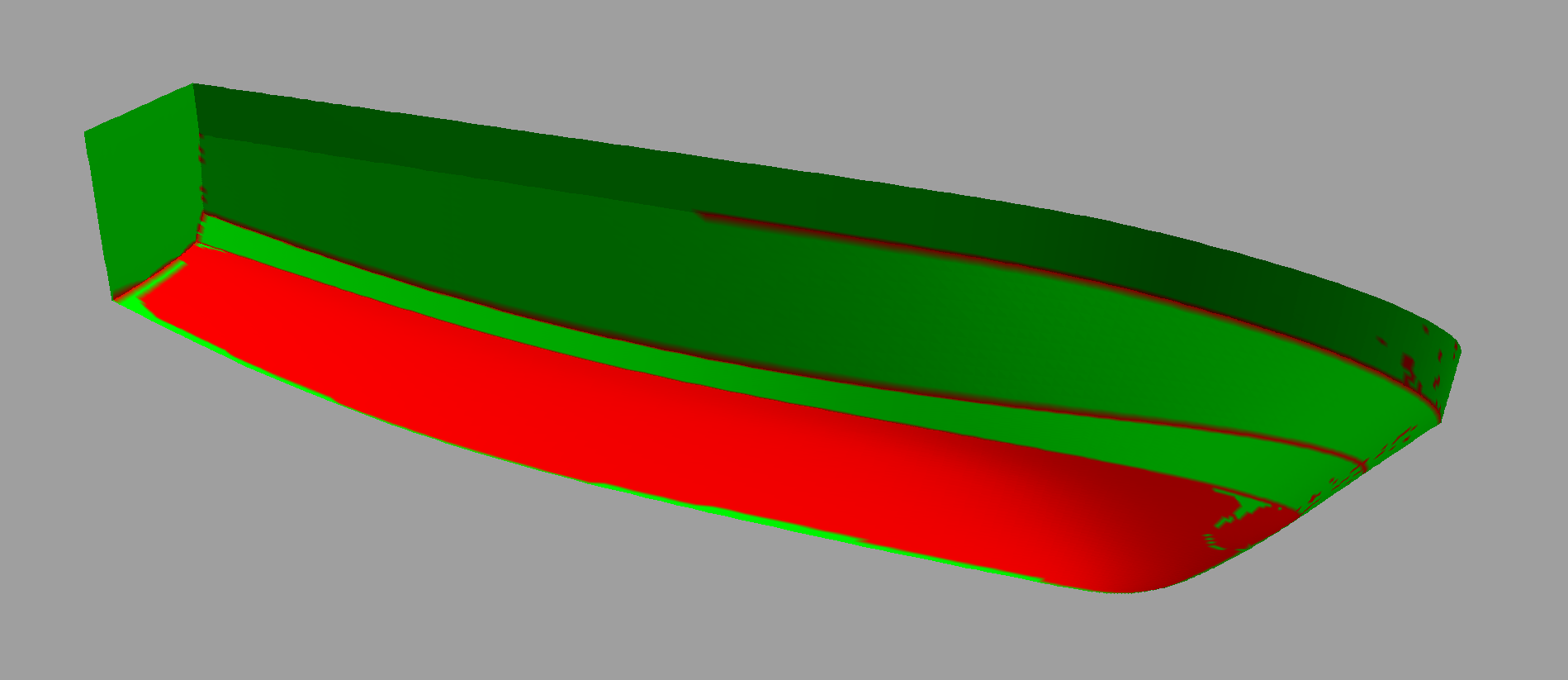
The image below shows the surface’s developability. Developable hulls can be build from flat plates which are only bend in one direction. Parts that are shaded green are developable, while parts that are shaded red are not developable. In our model, only the bottom part is not developable.
Conclusion
The modelling of a ship’s hull surface is one of the first steps in ship design. With this nice model, we can now make further studies in hydrostatics, hydrodynamics, structural analysis, propulsion and a lot more.
References
- FAO. 2026. Fishing Vessel Design Database (FVDD). Trawler - 17.5m. In: Fisheries and Aquaculture. Retrieved from https://www.fao.org/fishery/en/vesseldesign/mar-17